06/01/2025

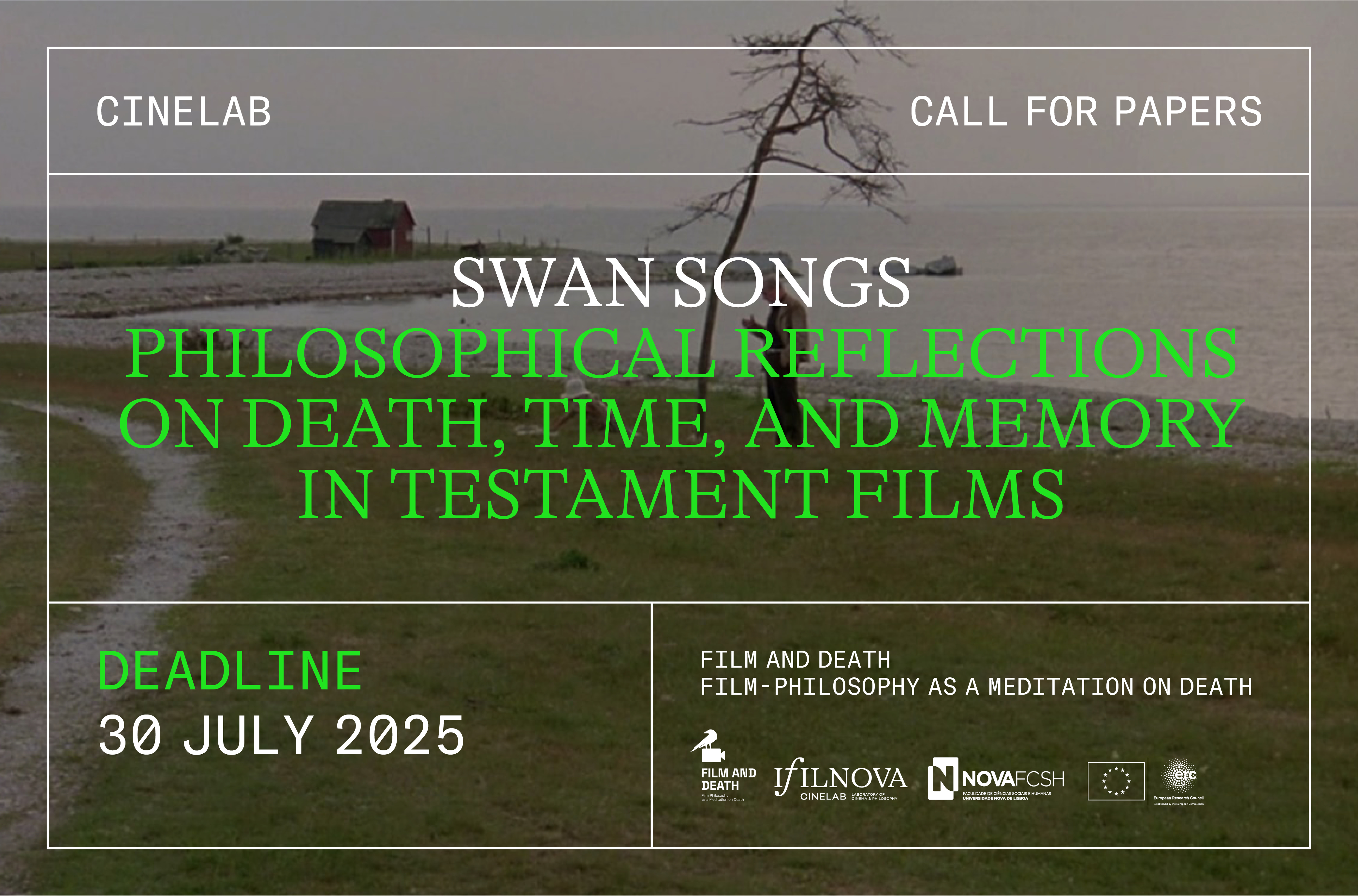
CfP Special Issue on Swan Songs: Philosophical Reflections on Death, Time, and Memory in Testament Films

Swan Songs: Philosophical Reflections on Death, Time, and Memory in Testament Films

Dedicated to the last films of renowned filmmakers, often referred to as “testament films” or “swan songs,” this Special Issue will examine their thematic, narrative, and stylistic elements, viewing these final works as profound summations of their creators’ careers and philosophical syntheses of their conceptions of life, death, and historical legacy.

Despite occasional discussions of testament films in philosophy, film theory, and director-specific analyses, the philosophical and artistic significance of these works as a distinct category remains largely unexplored. This Special Issue will address this research gap by defining “testament films” as a cohesive field of study, exploring their patterns and divergences, and interrogating how filmmakers approach mortality, transience, and legacy in their final works.

As suggested in Deleuze and Guattari’s “What Is Philosophy?”, the nature of philosophy—and, by extension, art—comes into sharper focus in old age, when approaching the end of life can lead to a self-reflective interrogation of one’s own (philosophical and artistic) work. Testament films provide a unique opportunity to explore this dynamic, offering audiences rich meditations on mortality, time, and the human condition. Filmmakers such as Akerman, Bergman, Dreyer, Fassbinder, Fellini, Kubrick, Kurosawa, Oliveira, Ozu, Satyajit Ray, Tarkovsky, Varda, and Welles, among others, have crafted final works that serve as both artistic summations and philosophical reflections. Films such as Tarkovsky’s “The Sacrifice” (1986) or Kubrick’s “Eyes Wide Shut” (1999) exemplify how these creations can act as meditative explorations of time, memory, faith, and legacy, often blurring the line between cinematic expression and the philosophies of death and time.

Key Questions:

  • How does an artist’s awareness of mortality shape their final works?
  • Can testament films be connected to distinct views of temporality as an accumulation of moments or as the exhaustion of possibility?
  • To what extent do these films intersect with, or contribute to, philosophical reflections on mortality and art from the 19th to the 21st centuries, as developed by thinkers such as Baudrillard, Bauman, Cavell, Freud, Heidegger, Jankélévitch, Kierkegaard, Landsberg, Simmel, Simon Critchley, Todd May, and Thomas Nagel?
  • How do ideas such as Heidegger’s “being-towards-death”, Kierkegaard’s concept of despair, Schopenhauer’s notion of transcendence, or Danto’s “end of art” intersect with testament films’ explorations of mortality, meaning, and artistic expression?
  • Could testament films serve as a modern continuation of philosophical meditations on death, such as those of Plato, the Sceptics, the Epicureans, the Stoics, and Montaigne? If so, what do they teach us, and how do these teachings intersect with, or diverge from, strictly philosophical discourse?
  • How do audiences interpret the meaning of death in art through art itself?

We invite contributions that address the interdisciplinary dialogue between philosophy and cinema, focusing on (but not limited to) the following topics:

  • Philosophical approaches to “Testament Films”;
  • Central themes of existentialism and mortality, time and memory, faith and transcendence, and the aesthetics of closure;
  • The concept of testament art, including philosophical frameworks, memento mori in cinema, and representations of mortality in film;
  • Analyses of testament films by Akerman, Bergman, Dreyer, Fassbinder, Fellini, Kubrick, Kurosawa, Oliveira, Ozu, Satyajit Ray, Tarkovsky, Varda, Welles, and others.

Guest Editors: Susana Viegas & Vasco Baptista Marques

Manuscript Submission Information

Manuscripts should be submitted online at www.mdpi.com by registering and logging in to this website. More information available here. Deadline for manuscript submissions: 30 July 2025.

Film and Death
Film and Death
  • About
    • Background and key aims
    • Overview
    • Team
    • Advisory Board
    • Related projects
    • References
  • Film-Phil Seminars
  • Outreach
    • Conferences
    • Reading Groups
    • Media
  • Publications
    • Articles
    • Books
  • VIDEOS
  • Blog
  • Job openings
  • Contact

Blog

Tags
Alain Resnais Alfred Hitchcock Animation anime Anna Elsner Anti-image Architecture and Cinema Bande Dessinée Bárbara Bergamaschi Béla Tarr Bernd Herzogenrath Bill Morrison Book Discussion Byron Davies Call for Papers Calls Catherine Malabou Catherine Wheatley Chantal Akerman Christine Reeh-Peters Cinema Journal of Philosophy Cinema Studies CJPMI Conferences Corey P. Cribb Cristóbal Escobar David Ferragut David H. Fleming David Lynch Davide Sisto Death and Technology Death-Image Deleuze Derrida Disappearence End-of-life care Events Farshad Zahedi Félix Guattari Female Biopic FIlm Film and Death Film Philosophy Film Studies Film-Phil Seminar Gilles Deleuze Grief Gülce Zeynep Bektaş Ingrid Rodrigues Gonçalves Jacques Derrida Jaime Pena Jakob A. Nilsson James Williams Jamieson Webster Japan Jean-Marc Rochette Jonathan Glazer Kanen Barad Lacrimae Rerum Lucas Ferraço Nassif Lucy Bolton Manoel de Oliveira Marc Cerisuelo Marco Grosoli Media Studies Michael Cholbi Michael Haneke Mortality Muhammad Haris Nélio Conceição New Queer Cinema Outi Hakola Palliative Care Paolo Taviani Patrícia Castello Branco Patricio Guzmán Pedro Inock Philosophy of Death Posthumanism Publications Queer Post-Cinema Queer Studies Reading Group Robert Sinnerbrink Salomé Lamas Seán Cubbit Slavoj Žižek Slow Cinema Stanley Cavell Star Biopic Susana Viegas Swan Songs Testament Films Thanatology Thomas E. Wartenberg Thomas Lamarre Tiago Cravidão Time-Image Vasco Baptista Marques Video Visiting Researcher Walter Benjamin
09/12/2025

Virtual Roundtable: Thomas Wartenberg’s “Thoughtful Cinema: Illustrating Philosophy Through Film” (2025)

Join us on February 3, 2026, at 18h00 London time for a virtual roundtable dedicated to Thomas Wartenberg’s new book “Thoughtful Cinema: Illustrating Philosophy Through Film” (Oxford University Press, 2025).  We are delighted that Thomas Wartenberg will also be joining the session, offering an opportunity for direct conversation with the author. This event brings together […]
30/09/2025

Extended Deadline! CfP Special Issue on Swan Songs: Philosophical Reflections on Death, Time, and Memory in Testament Films

We are happy to announce the new home for the Special Issue “Swan Songs: Philosophical Reflections on Death, Time, and Memory in Testament Films”!  The editors have chosen to publish it in Arts, an international, peer-reviewed, open-access journal (also published online by MDPI) devoted to research on all facets of the visual and performing arts, […]
09/01/2026

“Whose Deaths Are Worth Mourning? Gendered Death in a Turkish TV Series” by Gülce Zeynep Bektaş

Whose Deaths Are Worth Mourning? Gendered Death in a Turkish TV Series By Gülce Zeynep Bektaş (Yeditepe University) One of Turkey’s most-watched TV series, the mafia-themed Valley of the Wolves (Kurtlar Vadisi, 2003-2005) and its sequel series, Valley of the Wolves: Ambush (Kurtlar Vadisi Pusu, 2007–2016) frequently portray death, but not all of them are […]
07/01/2026

Susana Viegas and Lucas Ferraço Nassif at the School of Arts and Humanities, University of Lisbon

On 29 January, Lucas Ferraço Nassif and Susana Viegas will speak at an event on TV series, organised by the Programme in Literary Theory at the School of Arts and Humanities, University of Lisbon (C138-B). In the morning, Lucas Ferraço Nassif will speak about the micro-perceptions and death-images in anime with Studio Trigger’s show Kill la […]
07/01/2026

“Ars Moriendi”: screening and debate with Tiago Cravidão and Ana Catarina Infante

On January 29, Casa do Comum will host a screening of Ars Moriendi and a debate between the director Tiago Cravidão and Ana Catarina Infante. Ars Moriendi is an experimental film. It asks the same questions to social participants receiving palliative care and to actors portraying characters at the end of life. Six of the eight […]
1234…31
Hosted by
Supported by

Funded by the European Union (ERC, FILM AND DEATH, 101088956). Views and opinions expressed are however those of the author(s) only and do not necessarily reflect those of the European Union or the European Research Council Executive Agency. Neither the European Union nor the granting authority can be held responsible for them.

DESIGN