11/03/2025

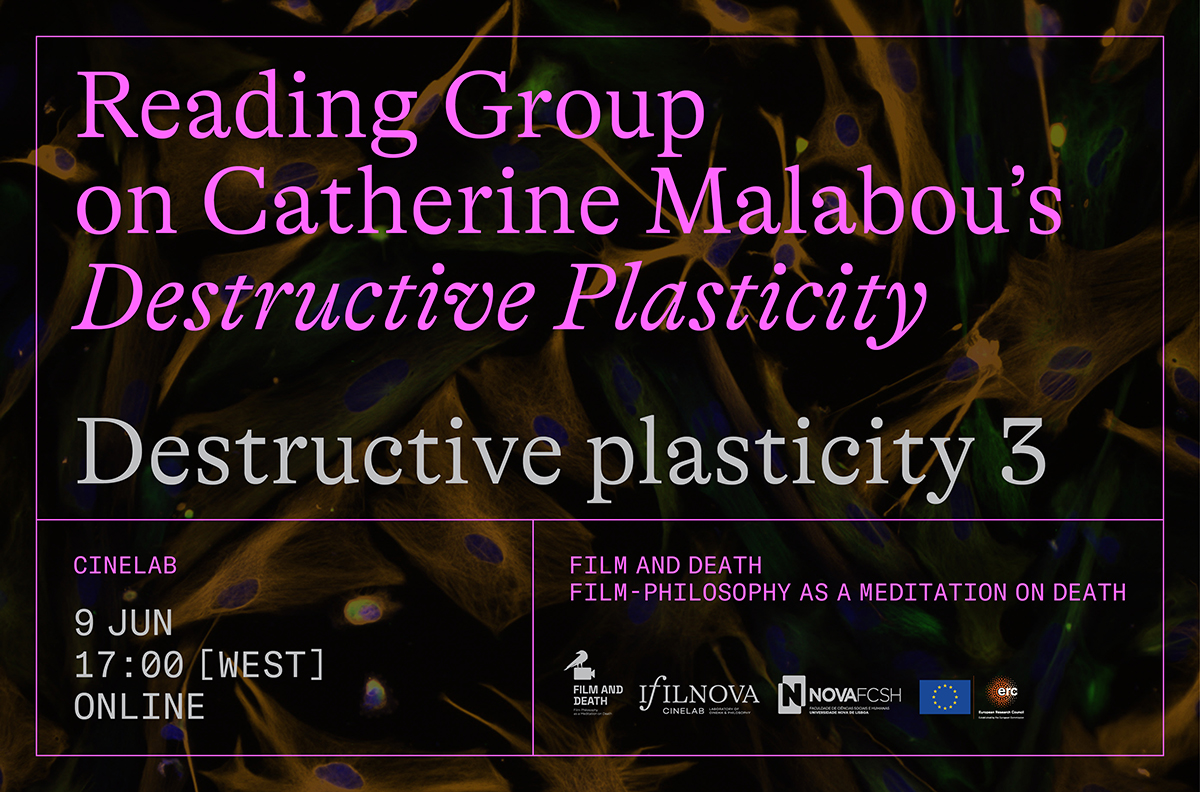
Reading Group on Catherine Malabou’s “Destructive Plasticity”

Catherine Malabou first arose to prominence in the International philosophical landscape in the 1990s, thanks to her groundbreaking interpretation of G. W. F. Hegel’s system as one revolving around plasticity, which eventually became the key concept of her own philosophical production. Itself a plastic concept, plasticity (“the nature of that which is ‘plastic’, being at once capable of receiving and of giving form”) strongly informed her eventual encounters with the neurosciences (convincingly showing that Hegel and the neurosciences share a very similar, plasticity-centred notion of human subjectivity) as well as with some of the most pressing issues of our present day: among many others, artificial intelligence, anarchism (advocating a reconnection between “anarchism” and “anarchy”) and feminism (advocating a reconnection between “feminism” and the “woman”; “difference” and “essence”).

Plasticity, however, is threefold. It does not consist merely in the capability of giving form and receiving form, but also in the destruction of form as the non-transcendental condition of possibility of the other two. In order to give and take form, subjectivity needs to “explode” from time to time, and face its own erasure. This is what Malabou calls “destructive plasticity”, a key facet of plasticity corresponding to the paramount role of death in the life processes, not unlike Freud’s “death drive” but beyond Freudian and Oedipal frameworks.

Our bi-weekly reading group will explore “destructive plasticity” through a selection of texts by Malabou to be commented and discussed during six one-hour seminar sessions, spread over little more than two months. The focus will be on the one hand on the tight conceptual interconnections between “destructive plasticity” and the other topics of Malabou’s philosophical production (feminism, trauma, the affect etc.), and on the other hand on its applicability for cinema.

Note that this reading group will be held exclusively online. Please, register in advance before each session. For the first session, please register here. After registering, you will receive a confirmation email containing information about joining the meeting. Registrants will also receive access to the texts.

Organised by Marco Grosoli, within the scope of the activities of the ERC project FILM AND DEATH. For any further questions, please write to mgrosoli@fcsh.unl.pt.

Programme

SESSION ONE: PLASTICITY – Monday, March 31, 2025 (17h–18h UTC+1/WEST)

Plasticity is “the nature of that which is ‘plastic’, being at once capable of receiving and of giving form”. What does Malabou mean by that? What are the philosophical roots of the concept of “plasticity”?

“The Future of Hegel: Plasticity, Temporality, Dialectic” [excerpt], Hypatia, Vol. 15, No. 4 (Autumn 2000), pp. 203-212.

“The Phoenix, the Spider, and the Salamander”, in Changing Difference: The Feminine and the Question of Philosophy, Cambridge: Polity Press, 2011, pp. 67-89.

Please register for the 1st session here.

SESSION TWO: PLASTICITY AND FEMINISM – Monday, April 14, 2025 (17h–18h UTC+1/WEST)

What does Malabou mean by “woman” and “feminine”? How is her conception of “difference” positioned within contemporary feminist debates?

“Woman’s Possibility, Philosophy’s Impossibility”, in Changing Difference: The Feminine and the Question of Philosophy, Cambridge: Polity Press, 2011, pp. 90-141.

Please register for the 2nd session here.

SESSION THREE: BEYOND THE MESSIANIC: AUTOAFFECTION, HETEROAFFECTION – Monday, May 5, 2025 (17h–18h UTC+1/WEST)

How can philosophical notions like “plasticity” and “affect” build bridges between continental philosophy and neurobiology? Why is this important in the overcoming of deconstructionism?

“How is Subjectivity Undergoing Deconstruction Today? Philosophy, Auto-Hetero-Affection and Neurobiological Emotion”, in Tyler M. Williams (ed.), Plasticity: The Promise of Explosion, Edinburgh: Edinburgh University Press, 2022, 243-251.

“The Neural Self: Damasio meets Descartes”, in Adrian Johnston and Catherine Malabou (Eds.), Self and Emotional Life: Philosophy, Psychoanalysis and Neuroscience, New York: Columbia University Press, 2013, pp. 26-34.

Clayton Crockett and Catherine Malabou, “Plasticity and the Future of Philosophy and Theology”, in Political Theology Vol. 11 No. 1 (2010), pp. 16-32.

Please register for the 3rd session here.

SESSION FOUR: DESTRUCTIVE PLASTICITY 1 – Monday, May 12, 2025 (17h–18h UTC+1/WEST)

What is “destructive plasticity”? What distinguishes it from Freud’s “death drive”?

“On Neural Plasticity, Trauma, and the Loss of Affects” [excerpt], in Adrian Johnston and Catherine Malabou (eds.), Self and Emotional Life: Philosophy, Psychoanalysis and Neuroscience, New York: Columbia University Press, 2013, pp. 56-60.

“Plasticity and Elasticity in Freud’s Beyond the Pleasure Principle”, in Tyler M. Williams (ed.), Plasticity: The Promise of Explosion, Edinburgh: Edinburgh University Press, 2022, 275-286.

Ontology of the Accident: an Essay on Destructive Plasticity, Cambridge: Polity Press, 2012, pp. 7-18.

Please register for the 4th session here.

SESSION FIVE: DESTRUCTIVE PLASTICITY 2 – Monday, May 26, 2025 (17h–18h UTC+1/WEST)

What can Spinoza’s conatus tell us about the neurological model of human subjectivity and about trauma in particular? What is, ultimately, an “ontology of the accident” and why ageing matters greatly in that regard?

Ontology of the Accident: an Essay on Destructive Plasticity, Cambridge: Polity Press, 2012, pp. 19-54.

Please register for the 5th session here.

SESSION SIX: DESTRUCTIVE PLASTICITY 3 – Monday, June 9, 2025 (17h–18h UTC+1/WEST)

What is Malabou’s “negative possibility” and what distinguishes it from Freud’s denegation? Could other examples be brought up besides those Malabou gives?

Ontology of the Accident: an Essay on Destructive Plasticity, Cambridge: Polity Press, 2012, pp. 55-91.

Please register for the 6th session here.

📸 Image credit: [Neurons] by [NIH Image Gallery] CC BY-NC 2.0

Film and Death
Film and Death
  • About
    • Background and key aims
    • Overview
    • Team
    • Advisory Board
    • Related projects
    • References
  • Film-Phil Seminars
  • Knowledge Map
  • Outreach
    • Conferences
    • Reading Groups
    • Media
  • Publications
    • Articles
    • Books
  • VIDEOS
  • Blog
  • Job openings
  • Contact

Blog

Tags
Aesthetics Alain Resnais Alfred Hitchcock Animation anime Anna Elsner Anti-image Architecture and Cinema Archive Artistic Studies Bande Dessinée Bárbara Bergamaschi Béla Tarr Bernd Herzogenrath Bill Morrison Book Discussion Byron Davies Call Call for Papers Call for Works Calls Catherine Malabou Catherine Wheatley Cátia Rodrigues Chantal Akerman Christian Petzold Christine Reeh-Peters Cían Ó Donnchadha Cinema Journal of Philosophy Cinema Studies CJPMI Conceptual Knowledge Map Conferences Corey P. Cribb Cristóbal Escobar Daniel Conway David Ferragut David H. Fleming David Lynch Davide Sisto Death and Technology Death in the Eyes 2 Death-Image Deleuze Derrida Diana Neiva Disappearence End-of-life care Events Farshad Zahedi Félix Guattari Female Biopic FIlm Film and Death Film Genres Film Philosophy Film Studies Film-Phil Seminar Gilles Deleuze Grief Gülce Zeynep Bektaş Ingrid Rodrigues Gonçalves Jacques Derrida Jaime Pena Jakob A. Nilsson James Williams Jamieson Webster Japan Jean-Marc Rochette Jonathan Glazer Kanen Barad Lacrimae Rerum Laurence Kent Lucas Ferraço Nassif Lucy Bolton Manoel de Oliveira Marc Cerisuelo Marco Grosoli Media Studies Memory Michael Cholbi Michael Haneke Mortality Muhammad Haris Natacha Gallucci Nélio Conceição New Queer Cinema Open Call Outi Hakola Palliative Care Paolo Taviani Patrícia Castello Branco Patricio Guzmán Pedro Inock Performance Philosophy of Cinema Philosophy of Death Posthumanism Publications Queer Post-Cinema Queer Studies Reading Group Research Grant Robert Sinnerbrink Salomé Lamas Seán Cubbit Short-Term Residencies Slavoj Žižek Slow Cinema Stanley Cavell Star Biopic Susana Viegas Swan Songs Testament Films Thanatology Thomas E. Wartenberg Thomas Lamarre Tiago Cravidão Time-Image Vanessa Freerks Vasco Baptista Marques Video Videoart Violence Visiting Researcher Walter Benjamin Workshop
24/08/2026

New Open Access article by Lucas Ferraço Nassif

We are happy to share that Lucas Ferraço Nassif, our post-doc researcher and FILM AND DEATH team member, has just published a new article titled “The epistemology of dizziness in psychoanalysis and schizoanalysis: Individuation, screen-based media, and the production of unconsciouses” in Revista Latinoamericana de Psicopatologia Fundamental (2026), no. 29. Concerned with the reconceptualization of […]
17/08/2026

New publication by Susana Viegas

Can a firefly and a toxic spore make us think differently about death? In her latest book chapter, Susana Viegas explores how Nausicaä of the Valley of the Wind and Grave of the Fireflies invite us to reflect on mortality through what she calls the death-image. Spores and fireflies, one commonly associated with toxicity, the other […]
07/08/2026

“Swan Songs: Philosophical Reflections on Death, Time, and Memory in Testament Films” is out now!

We are pleased to announce the completion of the Special Issue “Swan Songs: Philosophical Reflections on Death, Time, and Memory in Testament Films”, guest edited by Vasco Baptista Marques and Susana Viegas for Arts. The Special Issue brings together seven original articles examining testament films from a philosophical perspective. Rather than approaching filmmakers’ final works merely as […]
06/08/2026

New Open Access publication by Susana Viegas

We are pleased to share that the book chapter “Derrida on Cinema’s Spectral Images: Time, Repetition, and Belief” by PI Susana Viegas is now available in Open Access through the publisher Brill. Published in “Derrida and Film Studies”, edited by Kamil Lipiński and Andrzej Marzec (Brill, 2025), the chapter explores Jacques Derrida’s reflections on cinema […]
1234…45
Hosted by
Supported by

Funded by the European Union (ERC, FILM AND DEATH, 101088956). Views and opinions expressed are however those of the author(s) only and do not necessarily reflect those of the European Union or the European Research Council Executive Agency. Neither the European Union nor the granting authority can be held responsible for them.

DESIGN