10/02/2025

CfP Revista de Comunicação e Linguagens nº. 63: “Death-Images: Revisiting Deleuze’s “Time-Image” in cinema after 1985”

Death-Images: Revisiting Deleuze’s "Time-Image" in cinema after 1985

In her article “Death as Film-Philosophy’s Muse: Deleuzian Observations on Moving Images and the Nature of Time,” Susana Viegas has shown that Gilles Deleuze’s concept of the “time-image” (i.e. a way for moving images to present time breaking with the conception of the latter as a discrete sequence of moments, each mechanically linked to the previous and the next) is inseparable from conceiving of death in ways other than the mere interruption of a linear progression called “life.” That is to say, the “time-image” qua direct, non-mediated presentation of time cannot but be as well a “death-image” foreshadowing the presence of death before it happens in the future; an indirect, oblique way of expressing future nonexistence; a direct image of passing over time.

The “Lazarean subject”, i.e. the subject coming back from the dead as theorized most effectively in the cinematic practice of Alain Resnais (among others, in Guernica, 1950, Night and Fog, 1955, Hiroshima mon amour, 1959), is perhaps the most fitting exemplification of this convergence between “time-image” and “death-image”. To some extent, this convergence can be regarded as Deleuze’s contribution to a strand of French 20th century thought (e.g. Georges Bataille, Maurice Blanchot, Jacques Lacan, among others) fruitfully elaborating on what lies “between two deaths”, i.e. between the subject’s symbolic and real deaths.

The relationship between Deleuze’s cinematic taxonomy and history is a complex one – suffice it to mention the paramount importance of World War II (qua ultimate, collective trauma) in structuring his classification, down to the very division between his two tomes (Cinema 1: Movement-Image, 1983, and Cinema 2: Time-Image, 1985). Without going into the intricacies of this relationship, to affirm that a relationship of some kind with history is there in Deleuze’s taxonomy in the first place is safe enough for the following question to be legitimate and, arguably, inevitable: what happened to the “time-image” after the publication of Cinema 2?

Forty years after the release of Cinema 2: Time-Image, this special issue will collect essays on films and directors working after 1985 that exemplify the convergence between “time-image” and “death-image” in ways that are not perfectly coincident with the ways Deleuze put it in his cinema books but possibly illuminating it with the hindsight of a later historical perspective. We are looking for essays reflecting on post-1985 cinematic instances of this convergence and showing kinds of “death-images” that Deleuze could not have envisaged writing in 1985.

Essays dealing with films and directors from non-Western areas will be particularly welcome. As it is well-known, the section(s) of Cinema 2 on non-Western cinemas are deliberately tentative, and thus implicitly calling for future specification. Several major figures in recent so-called “World Cinema” (to name but a few: Jia Zhang-Ke, Lisandro Alonso, Apichatpong Weerasethakul, Abderramahne Sissako, Lav Diaz) engage deeply with “time-image”, and in a lot of cases their cinemas strongly relate to death and the “death-image” too. Essays on lesser-known figures would, however, be no less welcome.

Japan is of course a particularly important case in point. The atomic bombings of Hiroshima and Nagasaki, and their large-scale impact, profoundly informs Deleuze’s cinema diptych, and there is no shortage of Japanese works reflecting on them in a Deleuzian way (e.g. from Shohei Imamura’s Black Rain, 1989, to Nobuhiko Obayashi’s Labyrinth of Cinema, 2019; also, Yoji Yamada’s Tora-San series could hardly be seen as very Deleuzian as it unfolded in the 1970s and 1980s, and yet its 2019 culmination Tora-San, Wish You Were Here lends itself to be analysed at the intersection between “time-image” and “death-image” like very few others).

Manuscripts should be submitted online RCL - Journal of Communication and Languages.

Full manuscript submission deadline: May 31, 2025
Review process: July to October 2025
Editors’ decision: October 2025
Expected publication date: November 2025

Articles can be written in English, French, Spanish or Portuguese and will be blind peer reviewed. Visual essays will also be accepted. Formatting must be in accordance with the journal’s submission guidelines, and the submission must be made via the OJS platform.

Editors: Marco Grosoli, Lucas Ferraço Nassif, Vasco Marques e Susana Viegas

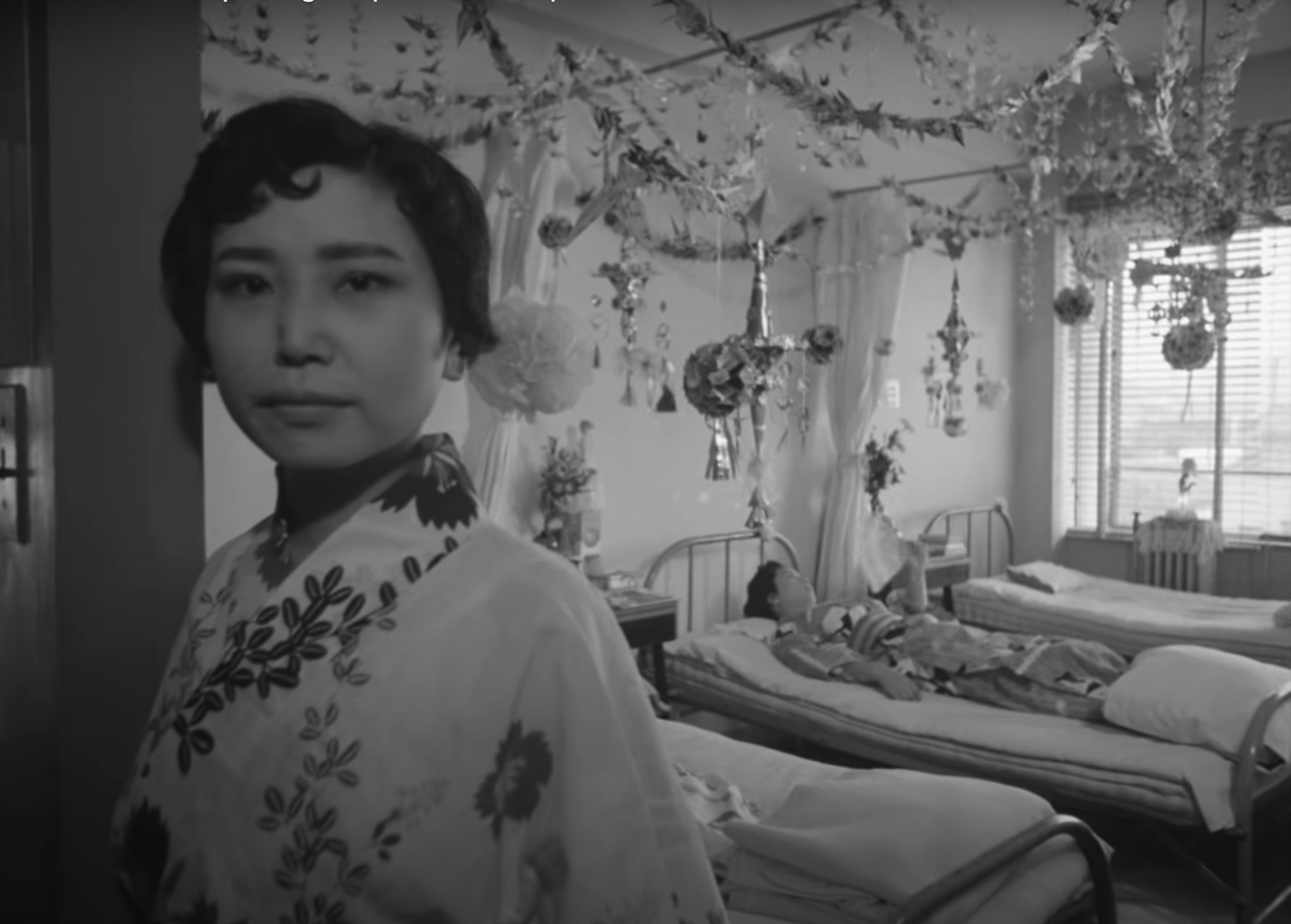
📸 Hiroshima, Mon Amour [1959], by Alain Resnais

Film and Death
Film and Death
  • About
    • Background and key aims
    • Overview
    • Team
    • Advisory Board
    • Related projects
    • References
  • Film-Phil Seminars
  • Knowledge Map
  • Outreach
    • Conferences
    • Reading Groups
    • Media
  • Publications
    • Articles
    • Books
  • VIDEOS
  • Blog
  • Job openings
  • Contact

Blog

Tags
Aesthetics Alain Resnais Alfred Hitchcock Animation anime Anna Elsner Anti-image Architecture and Cinema Archive Artistic Studies Bande Dessinée Bárbara Bergamaschi Béla Tarr Bernd Herzogenrath Bill Morrison Book Discussion Byron Davies Call Call for Papers Call for Works Calls Catherine Malabou Catherine Wheatley Cátia Rodrigues Chantal Akerman Christian Petzold Christine Reeh-Peters Cían Ó Donnchadha Cinema Journal of Philosophy Cinema Studies CJPMI Conceptual Knowledge Map Conferences Corey P. Cribb Cristóbal Escobar Daniel Conway David Ferragut David H. Fleming David Lynch Davide Sisto Death and Technology Death in the Eyes 2 Death-Image Deleuze Derrida Diana Neiva Disappearence End-of-life care Events Farshad Zahedi Félix Guattari Female Biopic FIlm Film and Death Film Genres Film Philosophy Film Studies Film-Phil Seminar Gilles Deleuze Grief Gülce Zeynep Bektaş Ingrid Rodrigues Gonçalves Jacques Derrida Jaime Pena Jakob A. Nilsson James Williams Jamieson Webster Japan Jean-Marc Rochette Jonathan Glazer Kanen Barad Lacrimae Rerum Laurence Kent Lucas Ferraço Nassif Lucy Bolton Manoel de Oliveira Marc Cerisuelo Marco Grosoli Media Studies Memory Michael Cholbi Michael Haneke Mortality Muhammad Haris Natacha Gallucci Nélio Conceição New Queer Cinema Open Call Outi Hakola Palliative Care Paolo Taviani Patrícia Castello Branco Patricio Guzmán Pedro Inock Performance Philosophy of Cinema Philosophy of Death Posthumanism Publications Queer Post-Cinema Queer Studies Reading Group Research Grant Robert Sinnerbrink Salomé Lamas Seán Cubbit Short-Term Residencies Slavoj Žižek Slow Cinema Stanley Cavell Star Biopic Susana Viegas Swan Songs Testament Films Thanatology Thomas E. Wartenberg Thomas Lamarre Tiago Cravidão Time-Image Vanessa Freerks Vasco Baptista Marques Video Videoart Violence Visiting Researcher Walter Benjamin Workshop
07/08/2026

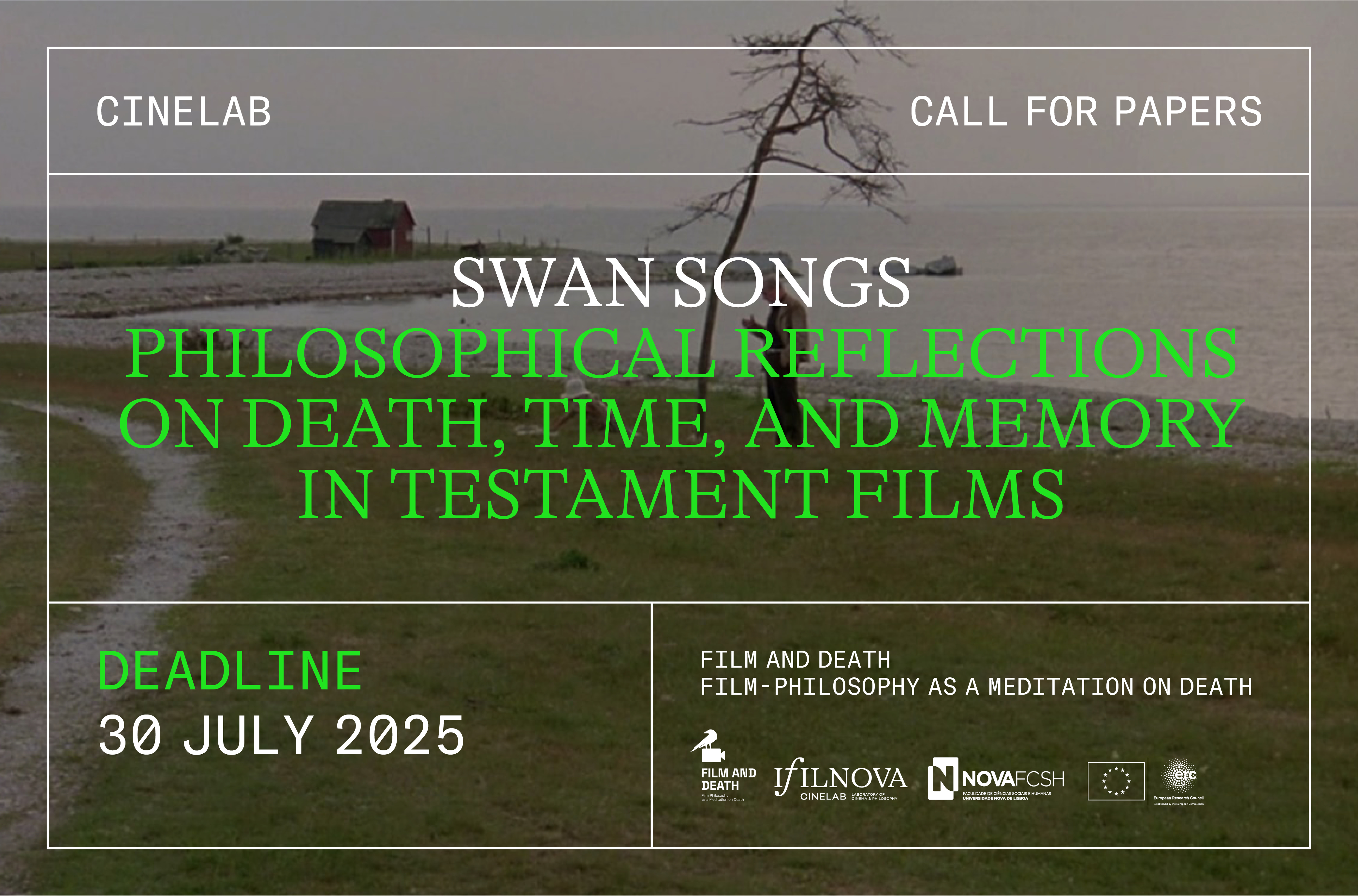
“Swan Songs: Philosophical Reflections on Death, Time, and Memory in Testament Films” is out now!

We are pleased to announce the completion of the Special Issue “Swan Songs: Philosophical Reflections on Death, Time, and Memory in Testament Films”, guest edited by Vasco Baptista Marques and Susana Viegas for Arts. The Special Issue brings together seven original articles examining testament films from a philosophical perspective. Rather than approaching filmmakers’ final works merely as […]
06/08/2026

New Open Access publication by Susana Viegas

We are pleased to share that the book chapter “Derrida on Cinema’s Spectral Images: Time, Repetition, and Belief” by PI Susana Viegas is now available in Open Access through the publisher Brill. Published in “Derrida and Film Studies”, edited by Kamil Lipiński and Andrzej Marzec (Brill, 2025), the chapter explores Jacques Derrida’s reflections on cinema […]
06/08/2026

Join us at the Goethe-Institut Portugal for the cycle “Falar sobre a morte (nunca matou ninguém)”!

Organized by the Goethe-Institut Portugal, with contributions from the FILM AND DEATH team, Death Café, the association Doulas do Fim da Vida, and many other partners, the festival Falar sobre a morte (nunca matou ninguém) [Speaking About Death (Never Killed Anyone)] will open on September 17 at 5:00 pm with the interactive sound installation Memorial […]
03/08/2026

Join Anderson Santos and Lucas Ferraço Nassif at the Centro Português de Psicanálise

On September 1, 7:00 PM, the Centro Português de Psicanálise (R. da Assunção 7, 2º) will host a talk by Anderson Santos, moderated by Lucas Ferraço Nassif, on “Félix Guattari: Psicanálise e o Paradigma Ético-Estético”. This presentation will be in Portuguese. This presentation addresses the shift initiated by Félix Guattari within psychoanalysis, as he proposes […]
1234…45
Hosted by
Supported by

Funded by the European Union (ERC, FILM AND DEATH, 101088956). Views and opinions expressed are however those of the author(s) only and do not necessarily reflect those of the European Union or the European Research Council Executive Agency. Neither the European Union nor the granting authority can be held responsible for them.

DESIGN